中国繁育最美蛇
New book chronicles Guangdong’s millennium of trade, tracing China’s commercial spirit_我的网站

A |
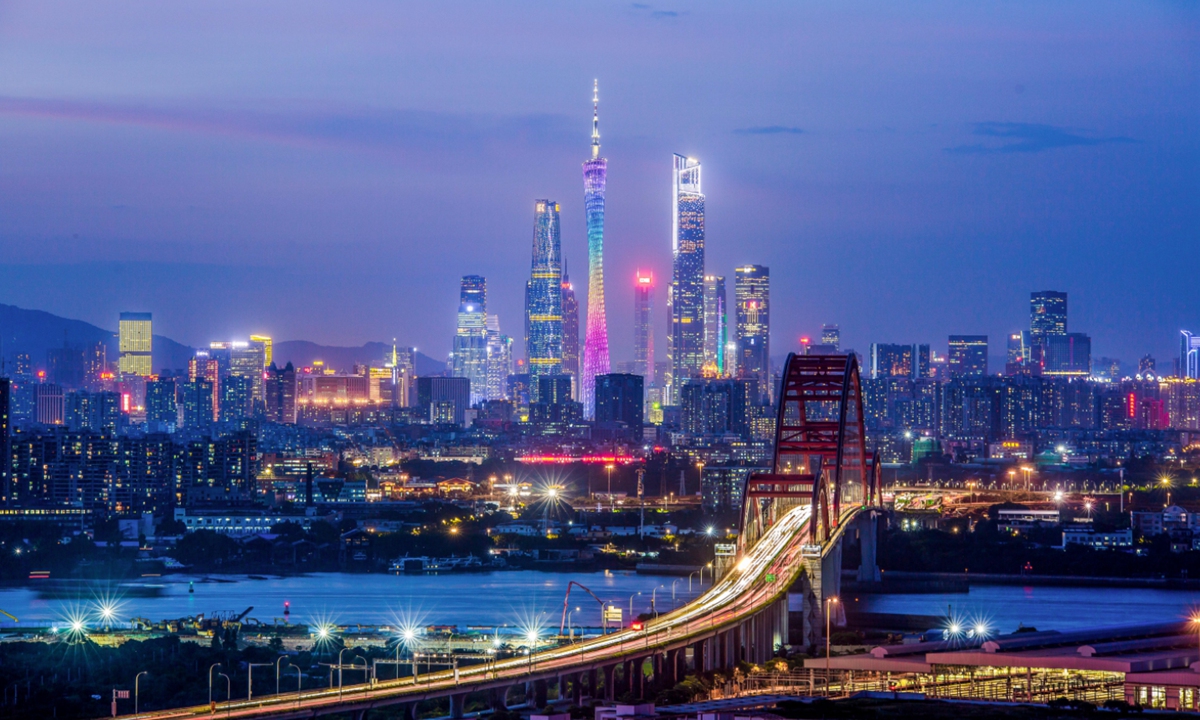
Night view of Guangzhou's CBD in South China's Guangdong Province Photo: VCG
The monumental full length reportage
Ballet of Commerce: The Epic of Guangdong's Foreign Trade by famous writer He Jianming is set to make its debut at the Southern China Book Fair from August 27 to 31 in Guangzhou, South China's Guangdong Province.
Published by the Guangdong Education Publishing House, the book is the first of its kind to offer a panoramic account of Guangdong's millennium of trade and will be presented as a special offering for 2026's APEC "China Year," Xu Xiaofeng, an editor with the publishing house, told the Global Times on Monday.
China will host the 33rd APEC Economic Leaders' Meeting in Shenzhen, Guangdong in November. It will be China's third time hosting the event, following Shanghai in 2001 and Beijing in 2014.
He, a former vice chairman of the China Writers Association and recipient of the Lifetime Achievement Award for Chinese Reportage Literature in 2023, told the Global Times on Monday that as the world watches the evolving trade relationship between China and the US, there is a growing need for a book that can help Western readers gain a deeper understanding of China's trading culture and how Chinese people have conducted business throughout history.
Guangdong marks the starting point of China's thousand-year maritime trade with the world. Through its foreign trade trajectory, the book reflects China's broader trade evolution, the enduring values of the Chinese spirit in the modern era, and the distinctive civilizational traits that have shaped China's rise, He noted.
Guangdong is both the birthplace of the ancient Maritime Silk Road and a pioneer of China's reform and opening-up. As a vital artery of commercial exchange between China and the rest of the world, the Maritime Silk Road has witnessed the evolution and transformation of the Chinese economy over the centuries.
During the Sui (581-618) and Tang (618-907) dynasties, silk was among the main goods transported along the route, earning it the name "Silk Road." During the Song (960-1279) and Yuan (1279-1368) dynasties, porcelain became a major export commodity, leading the route to be known as the "Porcelain Road." By the Ming (1368-1644) and Qing (1644-1911) dynasties, tea had emerged as a sought-after Chinese export in Europe, giving rise to yet another name - the "Tea Road," according to a report by the Counselor's Office of the Guangdong Provincial People's Government.
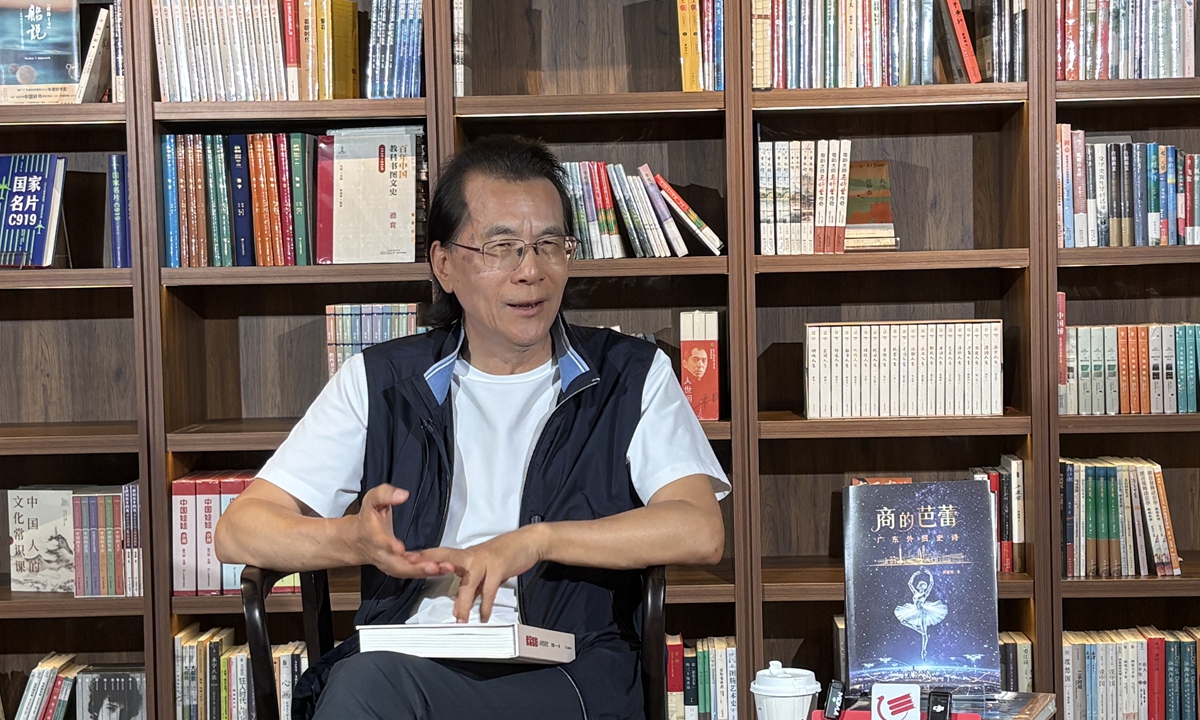
He Jianming talks about his new book on August 10. Photo: Wu Jie/GT
Mutual benefitGuangdong, China's largest foreign trade province, accounts for about one-fifth of the country's total trade and imports. As a major manufacturing hub with deep and extensive industrial chains, it creates significant demand for production factors, the Xinhua News Agency reported.
In the first half of this year, Guangdong's foreign trade reached 5.49 trillion yuan ($810 billion), surpassing the 5-trillion-yuan mark for the first time in the same period on record. The figure represented a year-on-year increase of 20.8 percent and accounted for 21.6 percent of China's total foreign trade. The province contributed an additional 944.71 billion yuan in trade volume, accounting for 25.6 percent of the country's foreign trade growth, according to official statistics released in July.
Having interviewed over 100 enterprises and institutions, He said that the book revisits the enduring legacy of the Maritime Silk Road, highlighting the exchanges between China and the West and the fusion of diverse civilizations.
"At the heart of Chinese business culture is the belief that 'harmony is the most valuable.' Rooted in traditional Chinese culture, this philosophy emphasizes cooperation and mutual benefit. Rather than viewing strength as a means to overpower others, Chinese merchants have traditionally embraced the idea that prosperity should be shared. When one grows stronger, others can benefit and achieve success together. This aspect of Chinese commercial culture remains unfamiliar to many in the Western world," said the 70-year-old writer.
Wang Yuanlin, a professor at the School of Humanities Guangzhou University, told the Nanfang Plus (a Guangdong-based news platform) that mutually beneficial and fair foreign trade policies, together with Guangdong merchants' long-standing tradition of integrity and win-win cooperation, have been key factors behind the province's enduring success in foreign trade.
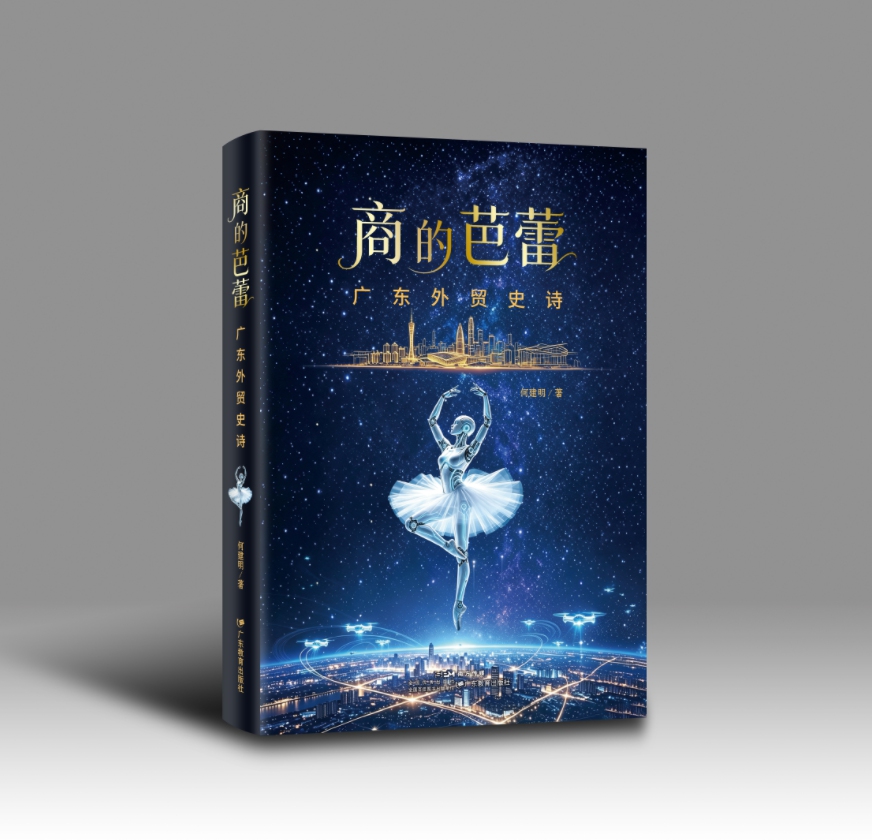
Ballet of Commerce: The Epic of Guangdong's Foreign Trade by He Jianming Photo: Courtesy of Xu Xiaofeng
Elegant businessThe author said that the choice of "ballet" in the book's title reflects the idea that Chinese business practices have developed into an art form - one characterized by balance and elegance.
"I want the Western world to understand that when the Industrial Revolution was just beginning and the Renaissance was sweeping across Europe, Chinese people had already mastered the art of commerce," He said.
Through conversations with entrepreneurs ranging from grassroots business founders to prominent corporate leaders such as Dong Mingzhu, chairperson of Gree Electric Appliances, He chronicles Guangdong's transformation from a millennia-old trading hub into a global industrial powerhouse.
"Just imagine: Employees at a private company can step into a space capsule after lunch and take a nap in their own private sleeping quarters. With a company like that, how could it not succeed?" he said.
From the exchange of handcrafted goods in the agricultural era to today's trade in high-tech products such as semiconductors and drones, Chinese people have developed a business culture centered on the principle that "harmony is most valuable" over thousands of years of commercial exchange.
This cultural tradition has become a key in driving the continued growth of trade in Guangdong and across China, He added.
。
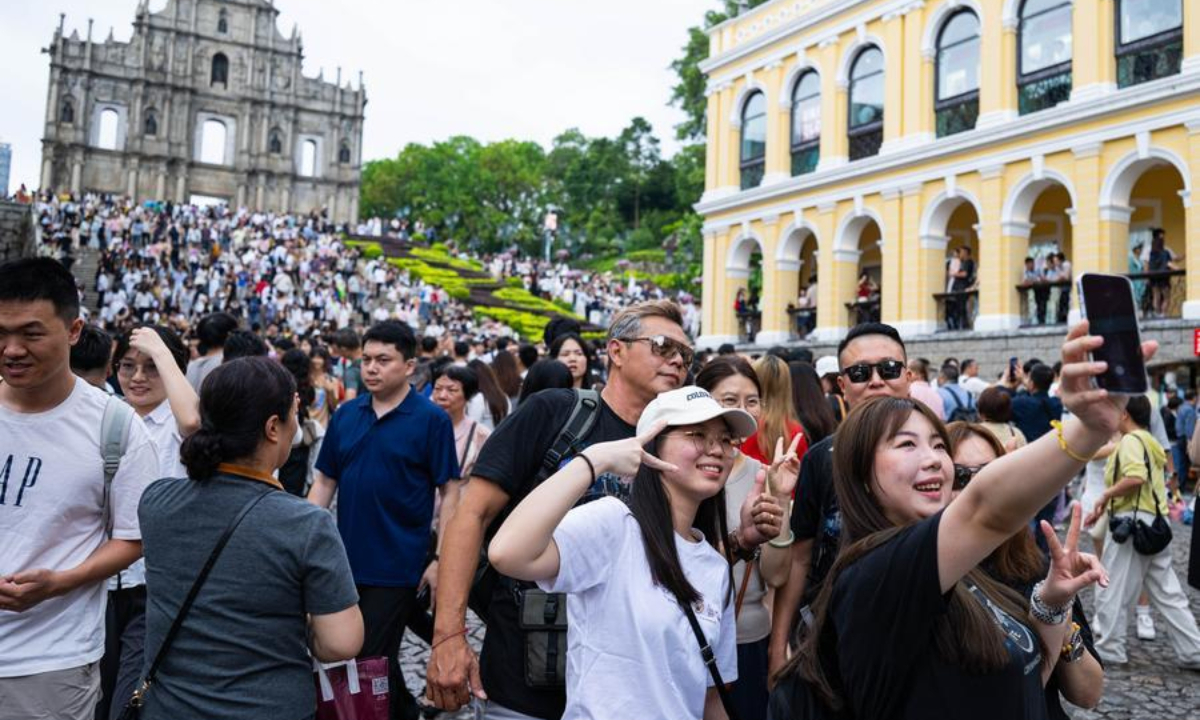
Tourists visit the Ruins of St. Paul's in Macao, south China, May 2, 2026. (Xinhua/Cheong Kam Ka)Nearly three decades after its return to China, Macao continues to explore new ways to sustain stability and prosperity under the "one country, two systems" policy, with successive five-year plans offering a long-term roadmap for its development.
Macao and its neighbor Hong Kong are China's two special administrative regions (SARs) governed under the "one country, two systems" policy. This arrangement, in place since China resumed the exercise of sovereignty over the two cities in the late 1990s, allows them to maintain their capitalist systems and ways of life within socialist China.
The third five-year plan of the Macao SAR, unveiled on Tuesday, sets out policy priorities for the next stage, focusing on economic diversification, social progress, and closer integration into national development, while ensuring security.
Since its return to China in 1999, Macao has evolved from a city once associated largely with casinos and gangster films into a vibrant international hub with a dynamic economy, a low crime rate and an increasingly comprehensive social welfare system. It now ranks among the world's wealthiest economies in terms of GDP per capita.
With the plan, the SAR government is proactively positioning Macao within the broader context of national development and actively implementing the relevant arrangements of the country's 15th Five-Year Plan (2026-2030), said Macao SAR Chief Executive Sam Hou Fai.
ECONOMIC DIVERSIFICATION
Economic diversification has remained a central theme throughout Macao's three five-year plans, from the first plan unveiled in 2016 to the latest one.
Sam said economic diversification is essential to sustaining Macao's long-term prosperity and stability and is a task the SAR government must tackle, no matter how difficult it may be.
According to Sam, the Macao SAR government will advance economic diversification through major projects and a government guidance fund to build Macao into a world tourism and leisure center and develop its priority industries, namely, big health, modern finance, high technology, exhibition and convention, as well as culture and sports.
The plan sets the target of raising the share of value added from non-gaming industries to around 60 percent of Macao's GDP by 2030.
Cheong Chok Man, director of the Policy Research and Regional Development Bureau under the Macao SAR government, said that setting such a target means Macao will need to intensify its efforts to achieve greater economic diversification.
Major projects aimed at promoting economic diversification during the period are expected to involve around 130 billion patacas (about 16.1 billion U.S. dollars) in budgeted investment.
For a small economy like Macao with a GDP of roughly 50 billion U.S. dollars in 2025, the investment represents a significant commitment, said Lao Chi Ngai, president of the Macao Economic Association.
BROADER INTEGRATION
The plan is designed to advance the high-quality development of the Guangdong-Macao In-Depth Cooperation Zone in Hengqin.
Located in Zhuhai, Guangdong Province, Hengqin is separated from Macao by a narrow stretch of water. The cooperation zone was established in 2021 to create new space for Macao's development.
This year marks a crucial period for the zone's second phase of development. The latest five-year plan calls for addressing challenges through reform and advancing deeper integration between Macao and Hengqin, with science and technology and education serving as key drivers.
The plan sets quantitative targets in areas including industrial diversification, cross-border flows of production factors, and the integrated provision and sharing of public services.
Richard W. Hu, dean of the Faculty of Social Sciences at the University of Macau, said the plan moves beyond integration in individual industries toward broader integration encompassing industries, people's livelihoods, talent and governance.
Hengqin is expected to develop into an integrated urban area that serves as an extension of Macao's industries and a vibrant cross-border community. In doing so, it could offer a landmark example of leveraging the institutional strengths of "one country, two systems" to foster closer regional synergy, Hu said.
SECURITY AS FOUNDATION
Alongside economic diversification and regional integration, the latest plan places security among its major priorities.
"Amid a complex and evolving international landscape, Macao faces potential challenges arising from a combination of traditional and non-traditional security risks," said Yin Yifen, director of the Social, Economic and Public Policy Research Center at Macao Polytechnic University.
He said the plan seeks to improve the legal framework and enforcement mechanisms for safeguarding national security, strengthen security governance in emerging areas such as cyberspace, data and artificial intelligence, and further develop smart policing.
It also places emphasis on national security education for young people.
"Making security an integral part of governance in the SAR will help lay a stronger foundation for economic diversification, improved livelihood and deeper integration between Macao and the mainland," Yin said.
。
Current article:http://ncp1isn.wengsengzhanhuangu.cyou/news/20260826_661.html
Published on:16:37:30
